Scanning Electrochemical Microscopy
Explore the principles and applications of SECM for high-resolution electrochemical mapping. Discover how researchers use this powerful technique to accelerate catalyst discovery and understand battery interfaces.
Core Principles
Understanding the feedback mechanism is essential for interpreting SECM data and designing effective experiments.
The Feedback Mode
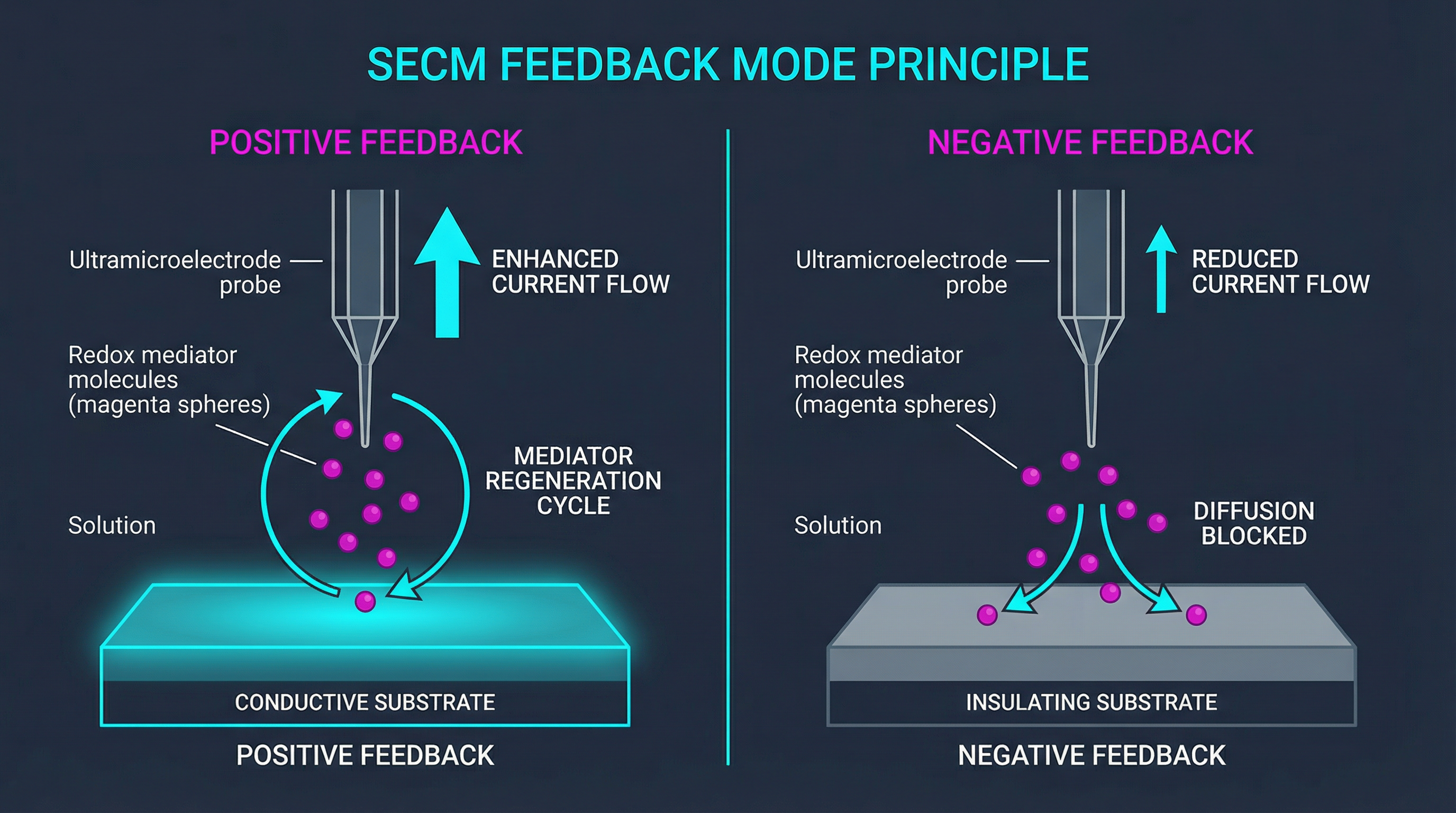
In feedback mode, an ultramicroelectrode (UME) probe is held at a potential where a redox mediator in solution is either oxidized or reduced. The probe current depends critically on the nature of the substrate below.
Conductive substrate regenerates the mediator, increasing probe current.
Insulating substrate blocks diffusion, decreasing probe current.
Measurement Configuration
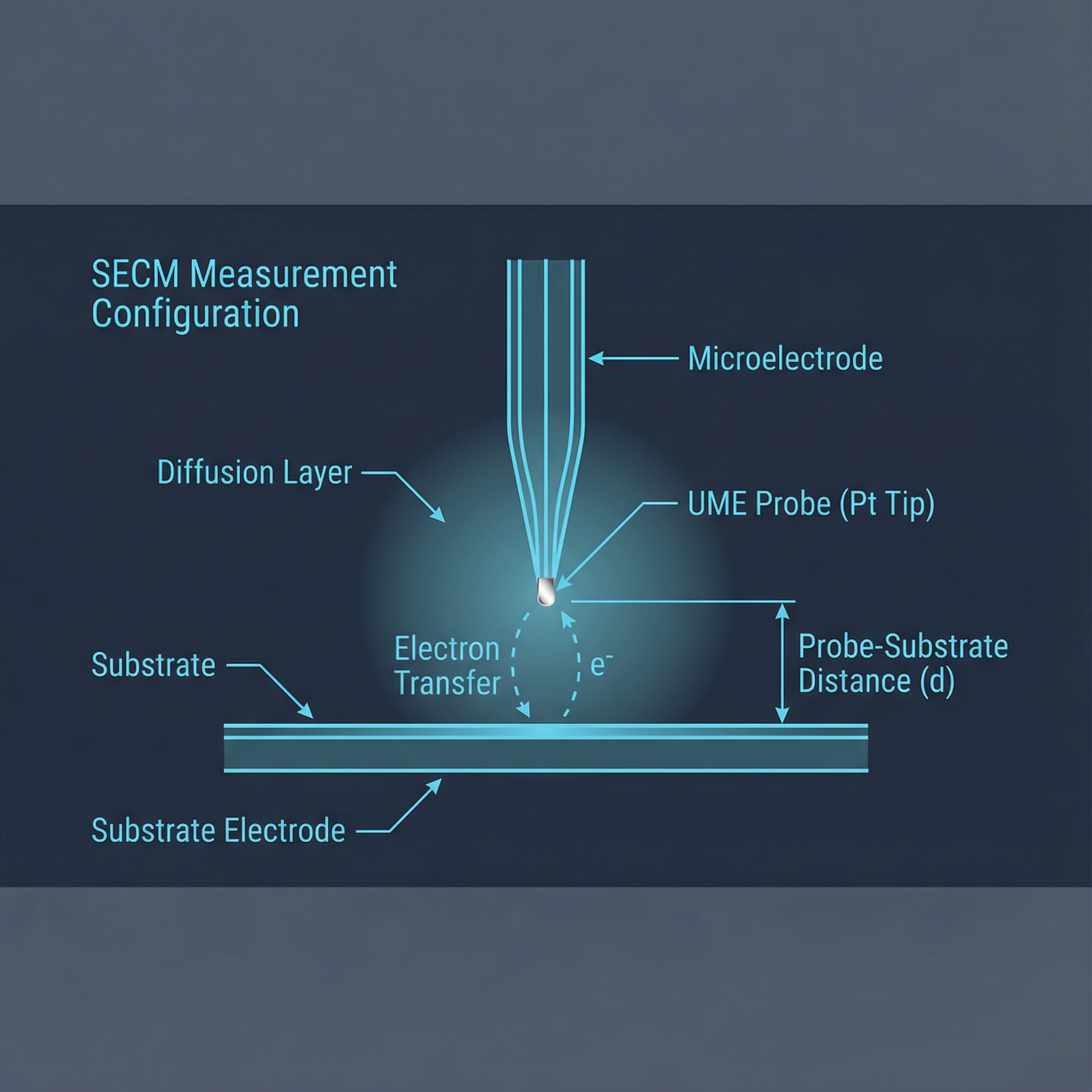
The SECM setup uses a bipotentiostat to independently control the potential of both the UME probe and the substrate. The probe-substrate distance (d) is critical and is typically set to 1-2 times the probe radius using an approach curve.
Approach Curve Simulator
Explore how probe current changes with distance for positive and negative feedback. Adjust the normalized distance (L) and observe the theoretical current response.
Probe-Substrate Distance
L = d/a (normalized distance)
I/I∞ at L = 2.0
Moderate enhancement
I/I∞ at L = 2.0
Near bulk
How to interpret: As the probe approaches (L decreases), positive feedback current increases above 1 (conductive substrate regenerates the mediator), while negative feedback current decreases below 1 (insulating substrate blocks diffusion). At large distances (L > 5), both curves approach 1 (bulk behavior).
Research Applications
Pt-Ag Alloy for OER
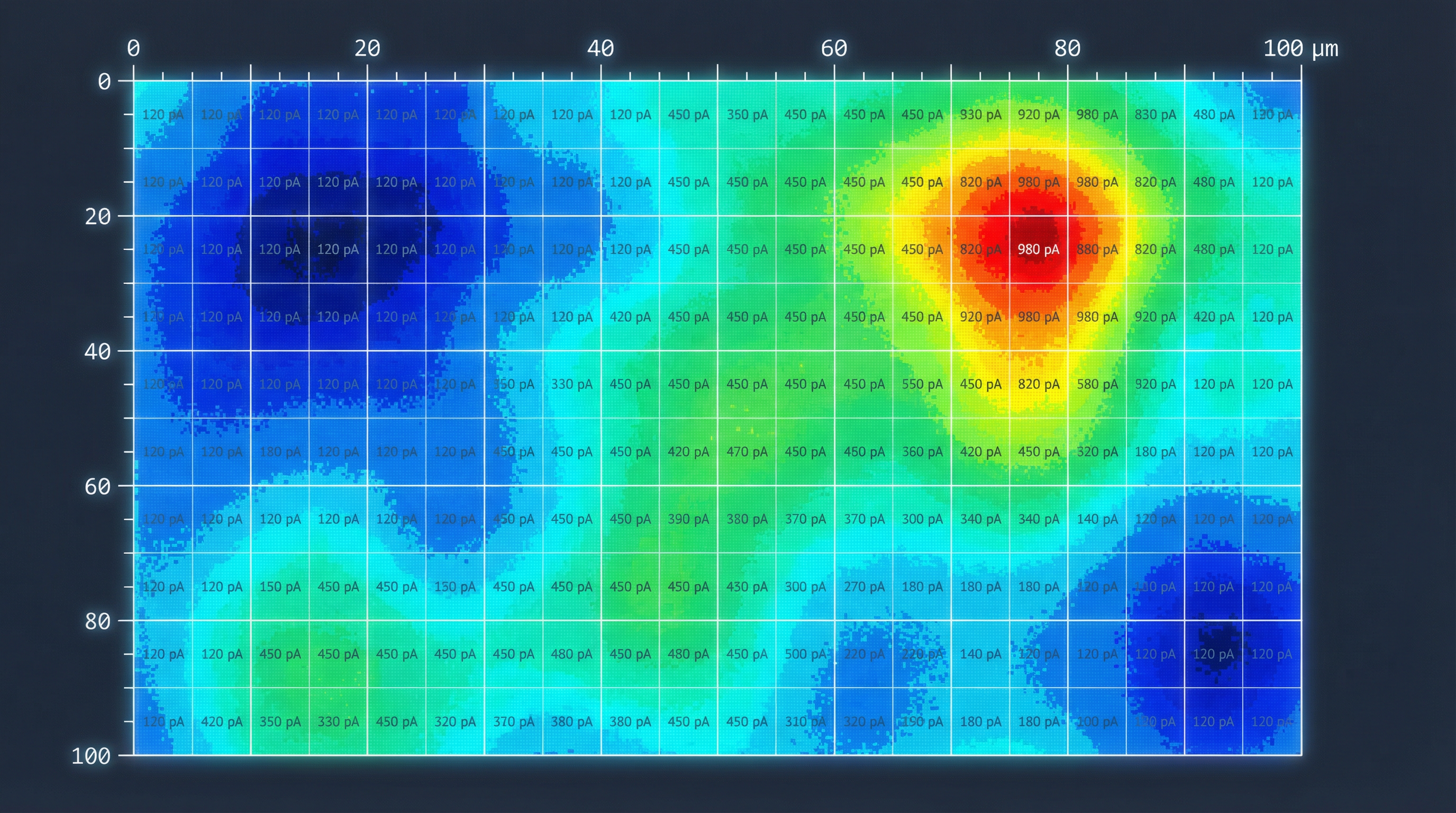
Researchers used SECM to screen a Pt-Ag alloy gradient library for OER activity. The probe detected evolved oxygen, with current directly proportional to catalytic activity. The resulting map immediately identified optimal alloy compositions as bright hotspots.
Key Findings
Test Your Knowledge
Challenge yourself with questions covering SECM fundamentals, techniques, and applications. Get immediate feedback and explanations.
What does UME stand for in SECM?
Video Tutorials
Watch step-by-step demonstrations of SECM techniques, from basic setup to advanced applications in catalysis and battery research.

Introduction to SECM
Source: BioLogic
Comprehensive introduction to Scanning Electrochemical Microscopy covering fundamentals, probe types, feedback modes, and measurement principles. Presented by BioLogic Science Instruments.
Tilt Correction & Approach Curves
Source: BioLogic
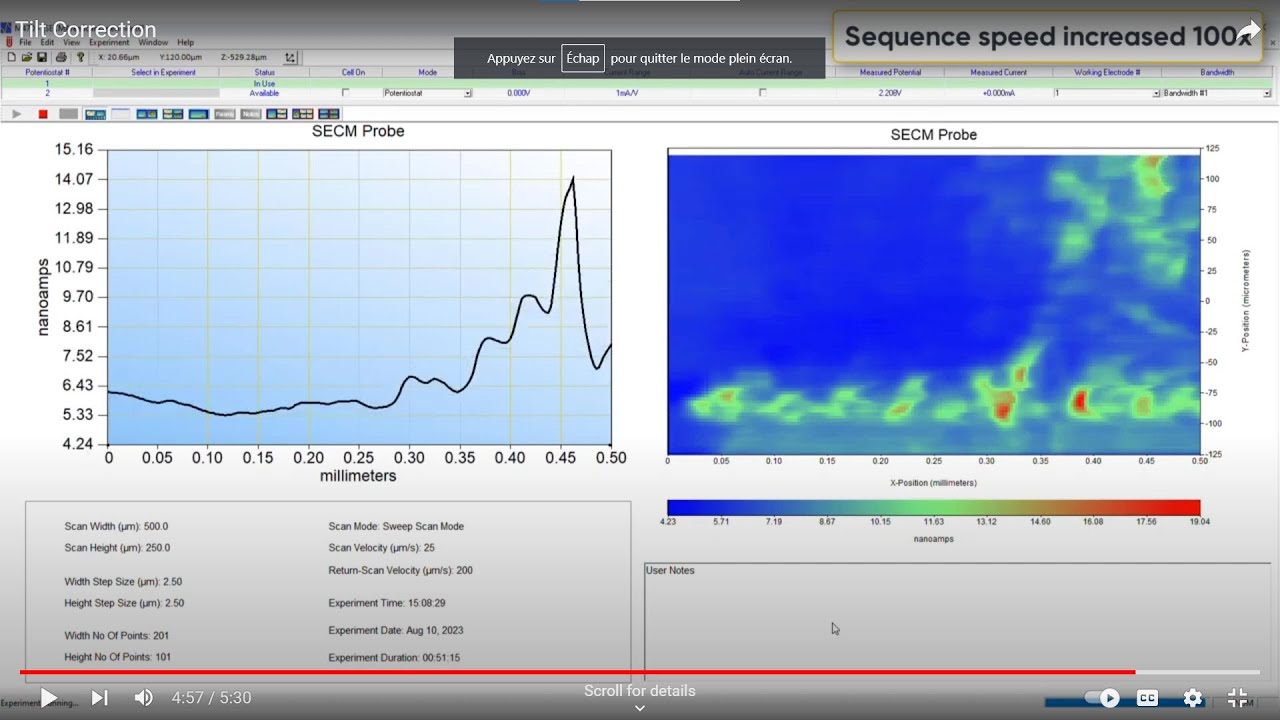
Demonstration of the approach curve topography extrapolation experiment on the M470, showing how to use three approach curves to create a surface map and correct for sample tilt.
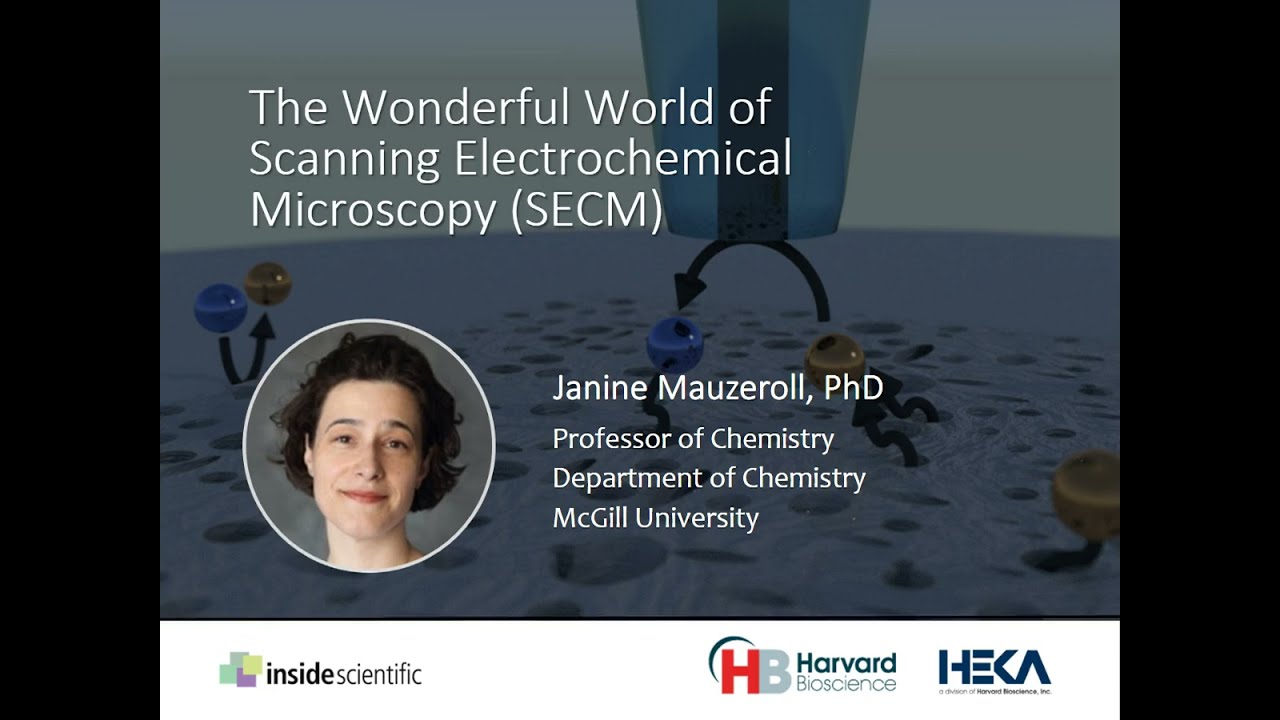
SECM Fundamentals & Applications
Source: Pine Research
Dr. Janine Mauzeroll discusses the fundamentals, critical experimental parameters, and recent applications for scanning electrochemical microscopy in this comprehensive webinar.
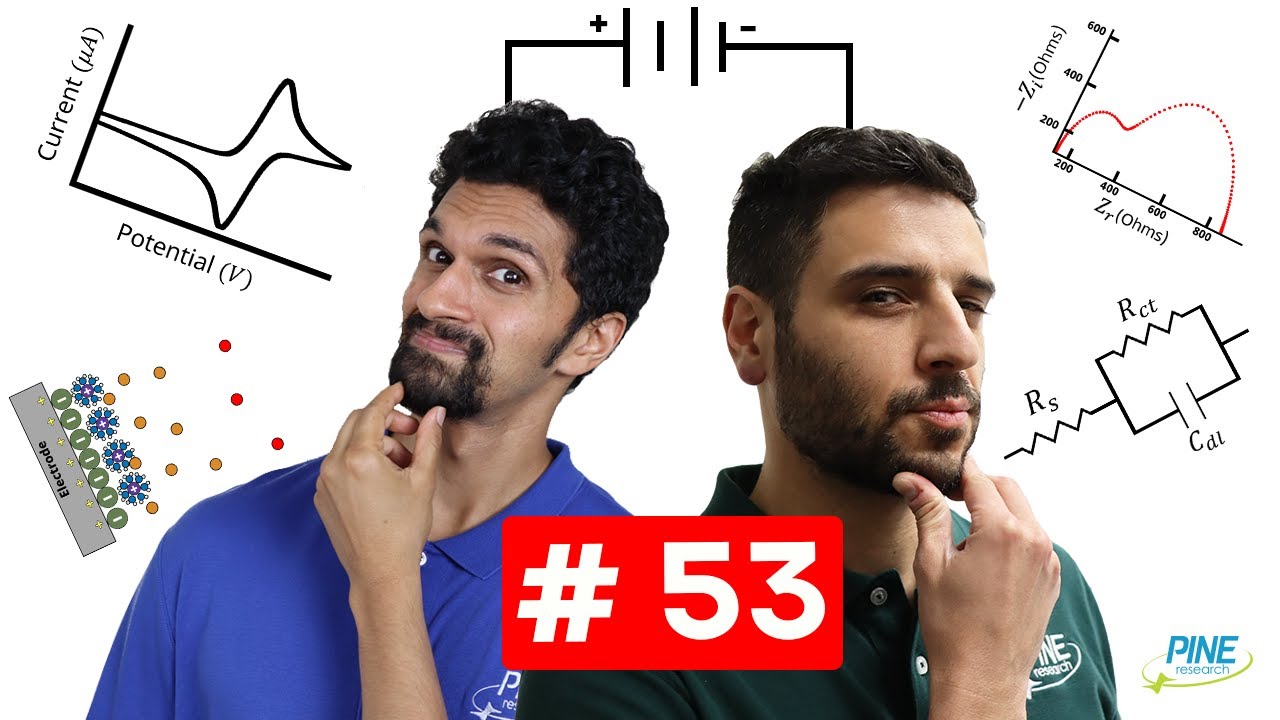
How SECM Works
Source: Pine Research
Episode #53 from Pine Research explaining scanning electrochemical microscopy principles, how the technique works, and practical considerations for experiments.
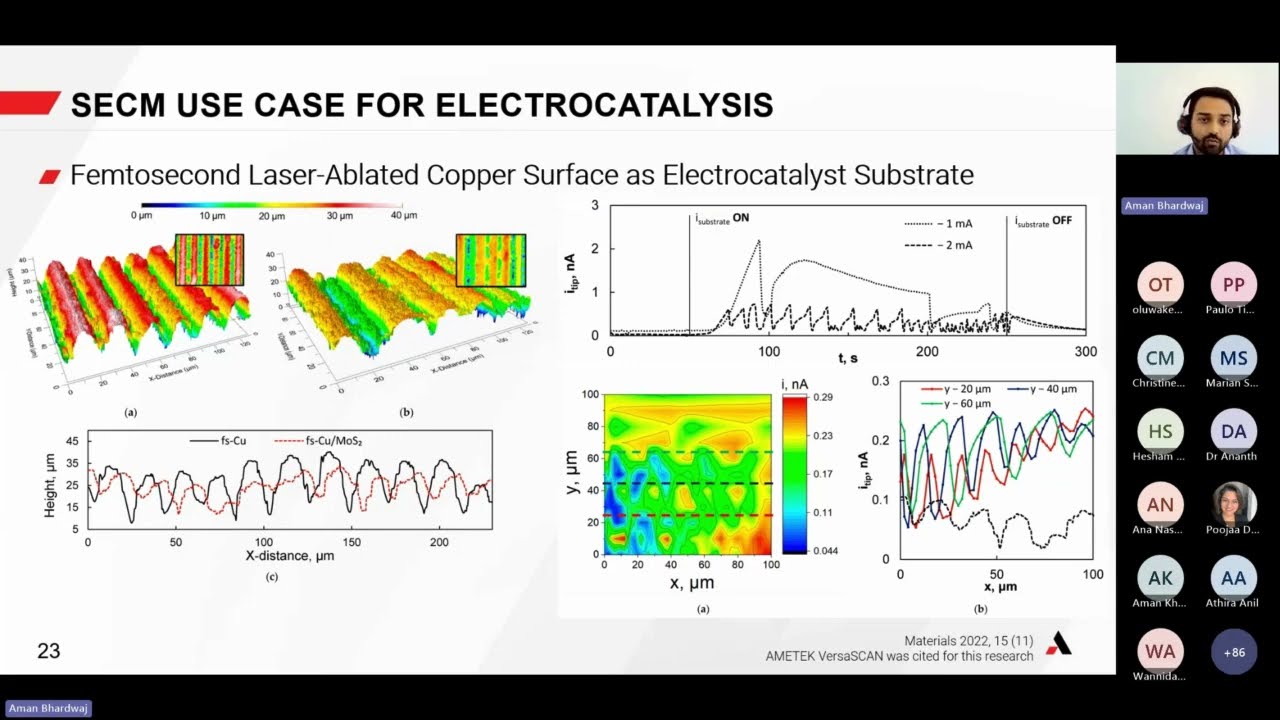
Exploring the Nanoscale with SECM
Source: Webinar
Webinar covering cutting-edge SECM techniques for probing electrochemical processes at the nanoscale, including advanced imaging and characterization methods.
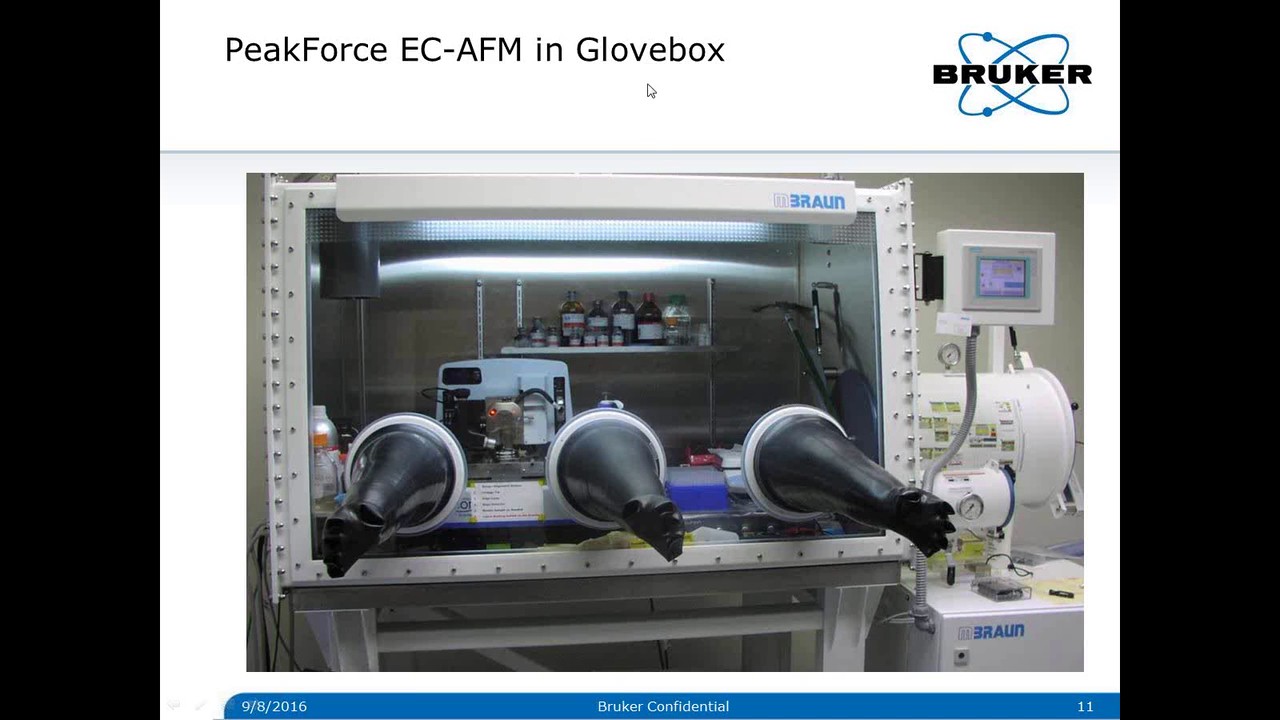
PeakForce AFM-SECM
Source: Bruker
Introduction to PeakForce scanning electrochemical microscopy, combining AFM and SECM for nanoscale electrochemical measurements with topographic correlation.
SECM Glossary
A searchable reference of key terms, abbreviations, and concepts in Scanning Electrochemical Microscopy.
Downloadable Resources
Access comprehensive documentation, protocols, and reference materials for your SECM research.
M470 SECM Protocol
Comprehensive operational guide for the BioLogic M470 system, including setup, procedures, and maintenance.
Electrocatalysis Handout
One-page summary of SECM applications in electrocatalysis, covering OER and HER case studies.
Comparative Analysis
Bridging electrocatalysis and battery research: how SECM methodologies translate between fields.
Get in Touch
Have questions about SECM techniques? Want to suggest new content? We'd love to hear from you.
Key Advantages
Local Resolution
Map electrochemical activity with sub-micrometer spatial resolution, revealing heterogeneity invisible to bulk methods.
Rapid Screening
Evaluate hundreds of catalyst compositions in a single experiment, accelerating materials discovery.
Quantitative Data
Extract kinetic parameters and reaction rate constants for local features and individual particles.
Versatile Modes
Feedback, generation/collection, and AC-SECM modes address diverse research questions.